

Why bubbles appear at the Kovar-glass sealing interface during hermetic sealing?
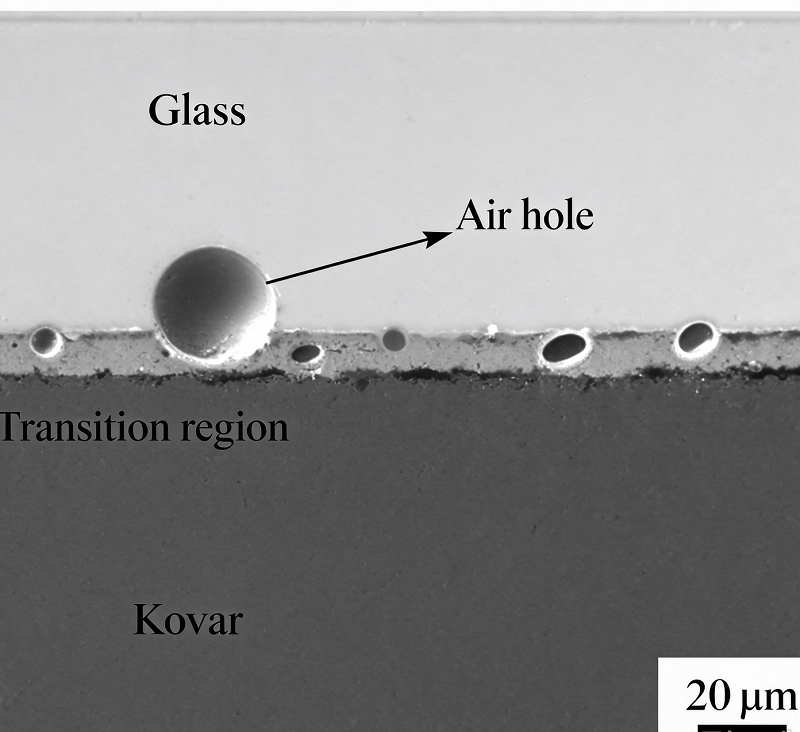
Interface bubbles are a common failure in Kovar hermetic sealing. The root causes are from carbon control, surface cleanliness and pre-oxidation parameters for glass-to-metal sealing.
Bubbles trapped between alloy Kovar and glass are one of the most frustrating issues for hermetic sealing teams working with ASTM F15 grade material (4J29 Kovar). These voids will cause helium leak failure and reduce seal strength of your glass-to-metal sealing assembly. Many customers wonder whether the problem comes from raw material or furnace process.
Three major root causes are frequently observed.
First, excessive carbon content in the material. At high sealing temperature, carbon reacts with residual oxygen and generates gas. This is why ECA strictly control carbon ≤0.03% for sealing-grade low-carbon Kovar material. Whether you process feedthroughs from strip, wire or rod stock, carbon control is non-negotiable for stable hermetic performance.
Second, poor surface cleanliness. Cutting fluid, oil residue or polishing dust left on the surface will decompose and produce gas during heating. Sealing surfaces need proper degreasing before pre-oxidation for reliable glass-to-metal bonding.
Third, improper pre-oxidation. Too thick or non-uniform oxide layers cannot be fully wetted by molten glass, forming trapped gaps that look like bubbles. A controlled oxide layer of 0.2–0.5 μm is the target for most borosilicate glass sealing with Kovar ASTM F15.
If bubbles occur only on occasional pieces, it is usually a process tuning issue. If bubbles appear consistently across all batches, we had better check the raw material quality and surface condition of the material stock.
Contact ECA for low-carbon Kovar strip, wire and rod with clean surface for glass-to-metal hermetic sealing.
 Why bubbles appear at the Kovar-glass sealing interface during hermetic sealing?
 Do you have quality concerns when importing Chinese Alloy 718 material for oil & gas application?
 What is the difference between API 6A CRA, AMS 5662 and AMS 5663?
 How does the cooling methods influence Alloy 718 material’ performance in oil & gas sector?